
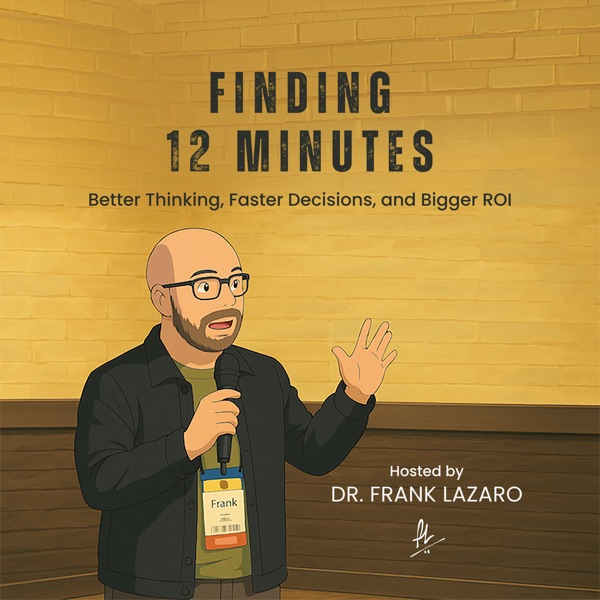
Resumen del episodio
If your competitors can buy the same AI tools, why should customers choose you? In this episode of Finding 12 Minutes, Dr. Frank Lazaro applies blue ocean thinking to AI strategy. He explains how to identify overlooked customers, challenge industry assumptions, and use eliminate, reduce, raise, and create to shape a different offering. A hypothetical project-screening example shows how efficiency could open new demand rather than simply accelerate an existing service. The practical takeaway: test a customer commitment and the delivery economics before scaling.
If your competitors can buy the same AI tools, why should customers choose you? In this episode of Finding 12 Minutes, Dr. Frank Lazaro applies blue ocean thinking to AI strategy. He explains how to identify overlooked customers, challenge industry assumptions, and use eliminate, reduce, raise, and create to shape a different offering. A hypothetical project-screening example shows how efficiency could open new demand rather than simply accelerate an existing service. The practical takeaway: test a customer commitment and the delivery economics before scaling.
Episodios
Episode 29: When Everyone Has AI, What Makes You Different?
EscuchadoIf your competitors can buy the same AI tools, why should customers choose you? In this episode of Finding 12 Minutes, Dr. Frank Lazaro applies blue ocean thinking to AI strategy. He explains how to identify overlooked customers, challenge industry assumptions, and use eliminate, reduce, raise, and create to shape a different offering. A hypothetical project-screening example shows how efficiency could open new demand rather than simply accelerate an existing service. The practical takeaway: test a customer commitment and the delivery economics before scaling.
Episode 28: The AI Productivity Paradox, More Output Is Not More Value
EscuchadoArtificial intelligence can help employees produce more work in less time, but higher output does not automatically create higher value. In this episode, Dr. Frank Lazaro explains the AI productivity paradox, identifies four places where efficiency gains disappear, and offers a practical approach to turning saved time into organizational capacity. Finding 12 minutes is only the beginning. The return comes from deciding where to put those minutes.
Episode 27: When AI Can Create, What Is the Creative’s Job?
EscuchadoArtificial intelligence can generate images, write copy, and produce endless creative variations. So, what does that mean for the creative professional? In this episode, Dr. Frank Lazaro reflects on his recent guest lecture at SCAD and the concerns students raised about AI’s impact on creative careers. He explains why human value still comes from understanding the problem, knowing the audience, choosing the right direction, applying craft, and exercising judgment. Creatives can embrace AI, use it selectively, or choose not to use it. Regardless of that choice, they remain responsible for giving the work purpose and owning the result.
Episode 26: AI Changes Management Before It Changes Anyone's Job
EscuchadoArtificial intelligence will change management before it replaces entire jobs. In this episode, Dr. Frank Lazaro explains how AI shifts managers from tracking activity to defining outcomes, from assigning tasks to designing workflows, and from reviewing everything to managing exceptions. He also offers a practical audit leaders can use to identify where AI can reduce administrative friction and free up time for judgment, coaching, and better decisions.
Episode 25: Human in the Loop Is Not a Strategy
Escuchado“Human in the loop” has become the standard answer to AI risk concerns, but adding a reviewer alone doesn't guarantee meaningful oversight. In this episode, Dr. Frank Lazaro explains the differences between being in, on, and over the loop. He also presents a practical framework for defining review responsibilities, matching oversight to risk, and measuring whether human involvement improves the workflow or merely moves the work.